
- Event
- Interview
- Q&A

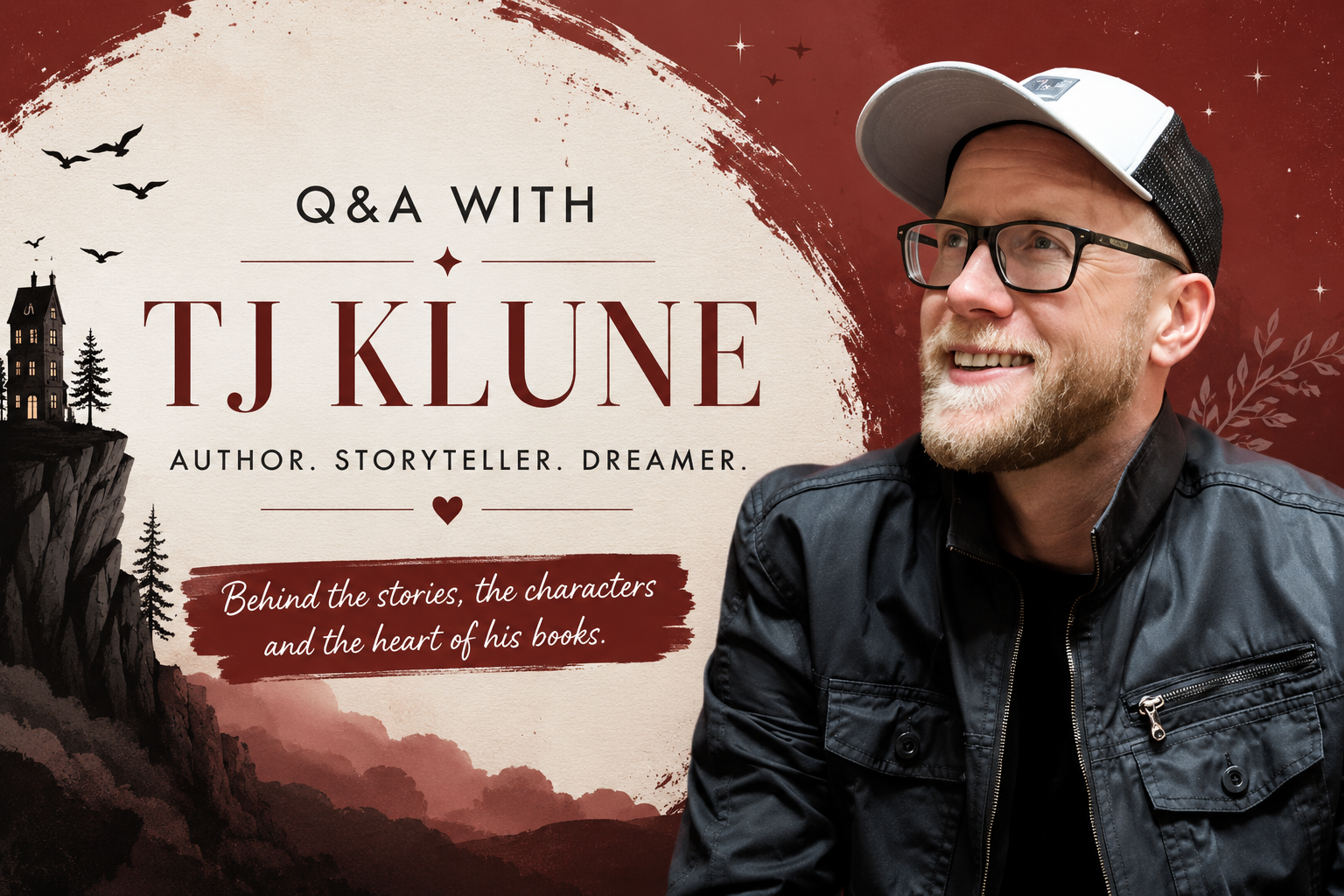
Last week, my book club had the opportunity to host a Q&A with TJ Klune, the acclaimed author of novels including The House in the Cerulean Sea, Bones Beneath My Skin, and In the Lives of Puppets. Klune has been a full-time author for around a decade, having first been published in 2011, and he proved to be an incredibly engaging and entertaining guest. I’m excited to share some of the highlights from our conversation.
What inspired you to become a writer?
Travis explained that he wanted to be an author from the age of four or five. Growing up in a poor family, he often found comfort and escape in books. As a queer person with ADHD, he spoke openly about feeling different and how reading gave him a place where he belonged.
He emphasised that if you truly want to pursue something, whether that’s writing or any other passion, you have to be willing to put in the work and make sacrifices. Those sacrifices have paid off for him, resulting in a career spanning more than 40 published books.
That doesn’t mean success came easily. In fact, he was quick to point out that his earliest work wasn’t very good. The key, he said, is persistence and continuing to improve.
What advice would you give aspiring authors?
Many people believe they only need one successful book to change everything, but Klune challenged that idea.
Instead, he encouraged writers to build a strong backlist and develop a portfolio of work. If readers enjoy one of your books, they’re likely to seek out others you’ve written.
He also stressed the importance of managing expectations. His first publishing advance was just $200 (around £150). Success often comes gradually rather than overnight.
His advice was simple: tell lots of stories, not just one. Keep writing, keep learning, and keep building your body of work.
Let’s talk about The House in the Cerulean Sea. What inspired you to write it?
Klune explained that he has always loved fantasy and wanted to create a story for readers who have felt different, particularly those who are queer, autistic, or otherwise outside what society considers “normal”. He also wanted to explore the bureaucracy that often shapes people’s lives.
To ensure authenticity, he carried out extensive research. He spoke with therapists, psychologists, people who had grown up in care, and adoptive parents. He wanted the children in the novel to feel like real children rather than adults trapped in children’s bodies, something he feels happens too often in fiction.
Theodore, for example, came from his fascination with people who understand multiple languages but can only communicate in one. In Theodore’s case, that language happens to be Wyvern.
Although the characters are fantastical, Klune said they all felt very real to him. Ultimately, the novel is about understanding people and cultures that are different from our own rather than expecting everyone to conform.
Why do you think so many readers have connected with this novel?
Klune believes timing played a significant role.
The book was originally due to be supported by a major international tour, but those plans were cancelled when the COVID-19 pandemic began. Instead, the novel arrived at a time when many people were feeling isolated, frightened, and uncertain about the future.
He also feels the book resonated because it reminds readers that being different isn’t something to fear. In a world often dominated by negative headlines and bad news, The House in the Cerulean Sea offered a hopeful story that celebrated kindness, acceptance, and belonging.
Linus begins as a strict follower of rules, while Arthur is much more free-spirited. What did you enjoy about writing their relationship?
“How often do you see a fat queer man as a main character?” Klune asked.
He described Linus as a proxy for the reader, someone who slowly discovers a larger, more colourful world. One example he highlighted is Linus seeing the ocean for the first time, a moment that symbolises colour and possibility entering his life.
Klune also enjoyed writing a romance between older characters. Love stories often focus on young people, but he wanted to show that love can be found at any age. Writing a romance involving characters in their forties was both refreshing and rewarding.
Which character is your favourite from The House in the Cerulean Sea?
“Chauncey, for sure,” he said. “He’s just such a fun character, and I had a great time writing him.”
Would you ever write a trans-led or lesbian-led novel from their point of view?
Klune’s answer was thoughtful.
While he is happy to include trans and lesbian characters in his stories, he said he would be unlikely to write a novel centred entirely on those experiences from their perspective.
His reasoning was that there are already many talented authors who can tell those stories from lived experience. He believes those voices are the most important and deserve to be amplified.
“I can include those characters,” he explained, “but telling those stories should come from the people who have lived them.”
Which character do you identify with most?
Without hesitation, Klune answered: Linus Baker.
Before becoming a full-time author, he spent more than a decade working a traditional office job in an insurance company. Like Linus, he spent years figuring out who he was and becoming comfortable enough to be his authentic self.
He hopes many readers will see aspects of themselves in Linus and relate to his personal journey.
Did you always plan to write a sequel to The House in the Cerulean Sea?
No.
Klune admitted that writing sequels can be difficult because he creates very specific rules for each of his fictional worlds. Originally, he intended The House in the Cerulean Sea to remain a standalone novel.
However, events in the real world changed his perspective.
He pointed to the ending of the first book, where Arthur must testify before the government. In 2022, similar events occurred in the United States when trans people were invited to speak before government bodies, only to face hostility and criticism.
After speaking with people who had experienced those events firsthand, Klune felt compelled to explore those themes further. This ultimately became the foundation for the sequel, told from Arthur’s perspective.
He said that if his books can change even one person’s opinion, then all the work will have been worthwhile.
Can you tell us about a potential third instalment?
Yes!
Klune revealed that he is currently writing a third — and potentially final — instalment in the Cerulean series.
This novel is set five years later and will be told from Lucy’s perspective. As Klune jokingly described it, the story explores “what happens when the Antichrist goes through puberty.”
He said he’s having an enormous amount of fun writing it.
What are you most proud of in your career?
Klune spoke enthusiastically about a forthcoming novel due for release in 2029, a project he has been working on for over ten years. The book draws heavily from the folklore and mythology of the Pacific Southwest, where he grew up.
He also revealed that another novel will be released in January 2027, inspired by his dog. Reassuring animal-loving readers, he quickly added that no dogs die in the story.
The novel will be titled The Stars Look Like Home — a title inspired by a Britney Spears lyric.
Is Stephen King an inspiration to your writing?
Absolutely.
Klune described Stephen King as one of his favourite authors and a major influence on his work. He even has an upcoming novel that serves as a homage to King.
He said he finds it incredibly inspiring that King continues to write and publish books after such a long and successful career.
Finally, what are you currently reading, and what book would you recommend?
Klune shared that he is currently reading I Am Behind You by John Ajvide Lindqvist.
As for recommendations, he highlighted Flamer by Mike Curato, a graphic novel that has been banned in some places. Klune believes it remains an important and powerful read, particularly because of the conversations it encourages.
Leave a Reply